
The Symptoms You'd Never Guess Were About Food
You wake up Tuesday with a headache and feel foggy all day. Wednesday your joints ache in a way that’s hard to explain. Thursday your skin flares. Friday your mood tanks and you can’t figure out why.
None of this happened right after a meal. No hives, no throat swelling, none of the dramatic reactions we connect with food allergies. You just feel… bad. On and off, for no obvious reason.
There’s a very good chance food is involved. Not through an allergy. Through sensitivity, one of the most overlooked causes of chronic, confusing symptoms in women.
Not All Food Reactions Are Allergies
Most of us learned about food allergies growing up. Peanuts can kill you, shellfish can make you swell up, keep the EpiPen close. Clear, fast, dramatic.
But there are actually four types of food reactions, and allergy is just one of them.
Food allergies are fast, potentially life-threatening immune reactions driven by IgE, the antibody behind classic allergies. If you have one, you already know.
Food intolerances happen when your digestive system lacks the enzyme to break something down. Lactose intolerance is the classic example: not enough lactase means dairy brings on gas, bloating, and urgency. These can usually be sorted out with some detective work and targeted digestive support.
Celiac disease is an autoimmune reaction to gluten, and the most serious form of gluten reactivity. It damages the intestine even with small exposures and requires strict lifelong avoidance.
Food sensitivities are the sneakiest of the four. They aren’t immediate or life-threatening. They’re delayed inflammatory reactions: your white blood cells release inflammatory chemicals in response to a food, and the symptoms can show up anywhere from a few hours to three days after you eat it. That delay is exactly what makes them so hard to trace.
The Symptoms Nobody Connects to Food
Here’s why this matters for moms: the symptom list for food sensitivities rarely looks like a “digestive issue.”
You might get gas, bloating, or constipation. Or you might not have any gut symptoms at all. What you’re more likely to notice:

Headaches and migraines. Some foods are well-known migraine triggers. But the duller, recurring headaches, the ones you’ve been treating with ibuprofen twice a week, can also trace back to foods that keep your body inflamed. If your headaches have no clear pattern, food is worth investigating before you write them off as stress or hormones.
Brain fog. One of the most common things I hear from clients after they find and remove their trigger foods is how surprised they are by the mental clarity that comes back. They’d stopped expecting to think clearly.
Fatigue that sleep doesn’t fix. When your immune system is reacting to foods you eat every day, that steady inflammation is exhausting. It’s the kind of tired that doesn’t budge no matter how long you’re in bed.
Joint aches. Inflammation from food sensitivities often settles into the joints. Plenty of clients who assumed they had early arthritis see their joint pain ease significantly once trigger foods are out.
Skin reactions. Eczema, rosacea, acne, and rashes that come out of nowhere are all common ways food-driven inflammation shows up on the skin.
Mood changes and irritability. Your gut and brain talk to each other constantly (that’s the gut-brain axis). When food sensitivities inflame the gut, it can show up as anxiety, low mood, or a shorter fuse.
Lighter, choppier sleep. A body that’s quietly fighting inflammation doesn’t rest deeply, even without any obvious digestive symptoms.
Why It Builds Up Over Time

With a food allergy, one bite of peanut causes an immediate reaction. Food sensitivities are cumulative. You might handle a small amount of a trigger food without noticing anything. But eat it every day, as most of us do with dairy, wheat, eggs, or corn, and the immune response quietly builds until you cross a threshold and symptoms show up out of nowhere.
That’s also why the symptoms seem random. They respond to load, not to a single meal. A stressful week can push you over the edge with a food that usually seems fine. So can being sick or going through a hormonal shift.
Food sensitivities respond to load, not to a single meal. That’s why the pattern feels random, and why it’s so easy to miss.
The Leaky Gut Connection

Food sensitivities don’t come from nowhere. They often follow increased intestinal permeability, commonly called leaky gut. When the tight junctions in your gut lining loosen (from chronic stress, antibiotics, a rough diet, or ongoing inflammation), larger food particles slip into the bloodstream. Your immune system flags them as threats and reacts.
That’s why removing trigger foods helps but often doesn’t solve the problem on its own. Healing the gut lining, rebalancing the microbiome (the community of bacteria living in your digestive tract), and calming gut inflammation is what keeps new sensitivities from forming and lets old ones fade.
How to Figure Out What’s Triggering You
There are two main approaches. The right one depends on your situation.
The elimination diet is the gold standard, and it’s free. You remove the most common triggers (typically gluten, dairy, eggs, soy, corn, and shellfish) for 4 to 6 weeks, then bring them back one at a time while tracking symptoms. Done well, it tells you more about your own reactions than almost any test. The catch: it takes discipline, and it goes better with guidance.
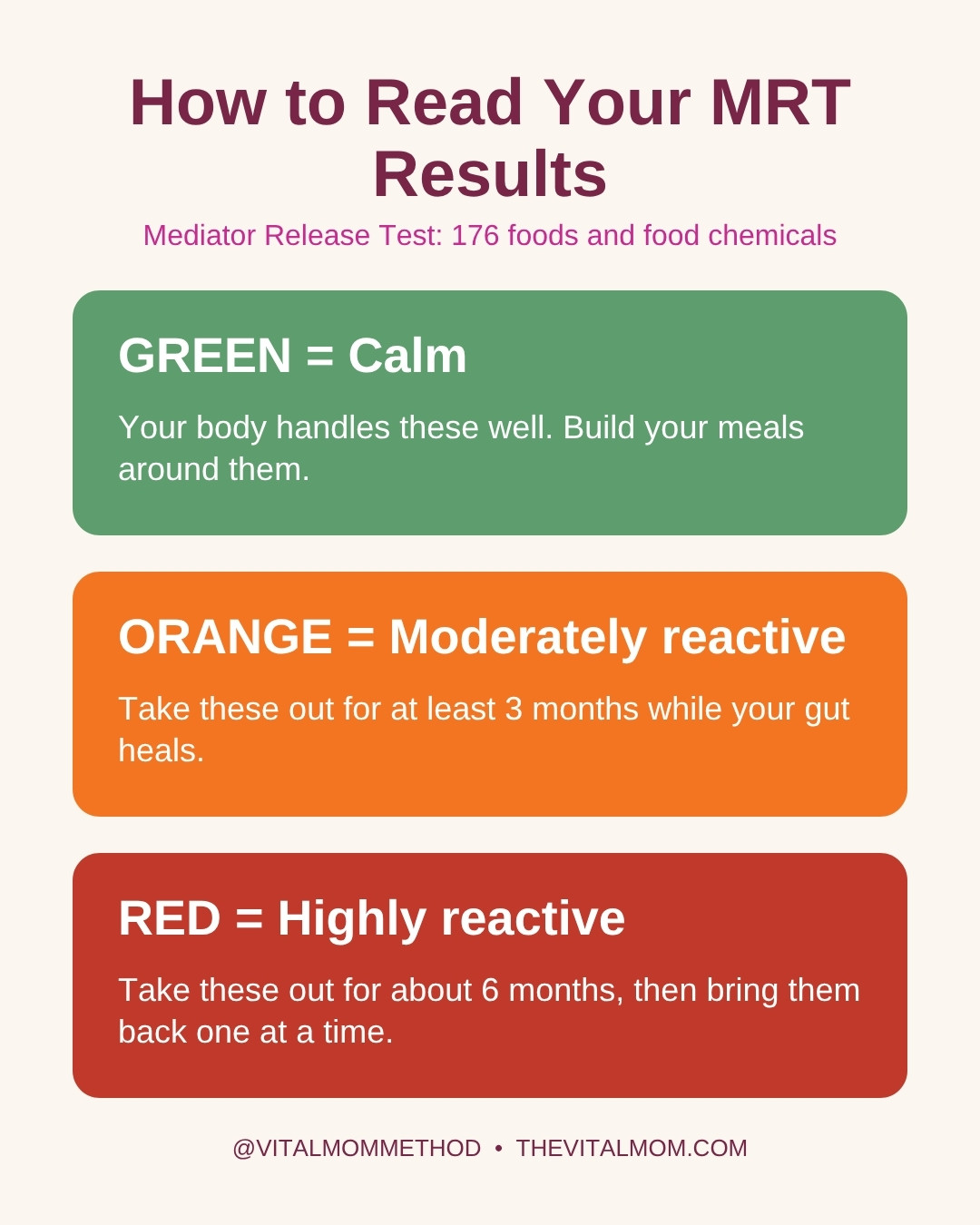
The MRT (Mediator Release Test) is the food sensitivity test I use. It’s a blood test that measures how your white blood cells react to 176 foods and food chemicals. When a cell reacts, it releases inflammatory chemicals called mediators, and that release is what drives the delayed symptoms. Results come back color-coded: green foods are calm, orange foods are moderately reactive, and red foods are highly reactive.
The MRT catches the curveballs. Sometimes it’s not gluten or dairy at all. Sometimes it’s the almonds, the broccoli, or the turkey you eat every single day because you think it’s good for you.
Here’s how I use it:
Pull the reactive foods. Orange foods come out for at least three months, red foods for about six.
Rotate the rest. Foods that tested close to the line, and foods that weren’t on the panel, get eaten every few days instead of daily.
Heal the gut at the same time. I always pair the MRT with a stool test like the GI-MAP, because sensitivities usually trace back to what’s happening in the gut. The MRT isn’t a stand-alone test. Taking the inflammatory foods identified by the MRT out of the diet creates an ideal healing window to go and balance the gut (address dysbiosis, insufficiencies, overgrowths, etc.). Balancing the gut fortifies the gut lining and increased immune resilience, making it less likely food sensitivities will reoccure, breaking the "whack a mole" cycle that can happen when you eliminate food without the combination healing work.
Bring foods back one at a time. After the gut has had time to heal, we test each food and watch for reactions over the next 72 hours. Many foods come back safely and if not, we know rather than guess what foods are still problematic.
You’re Not Imagining It
If you’ve been told your symptoms are stress, anxiety, or “just how you are,” and you suspect food is involved, take that instinct seriously.
Finding and removing food triggers has changed life for more of my clients than I can count. The joint pain that got written off as early arthritis. The brain fog everyone blamed on being a busy mom. The skin no cream could fix.
These aren’t unsolvable mysteries. They’re patterns waiting to be investigated.
Your Next Step
Wondering what your labs would show? Book a free call.